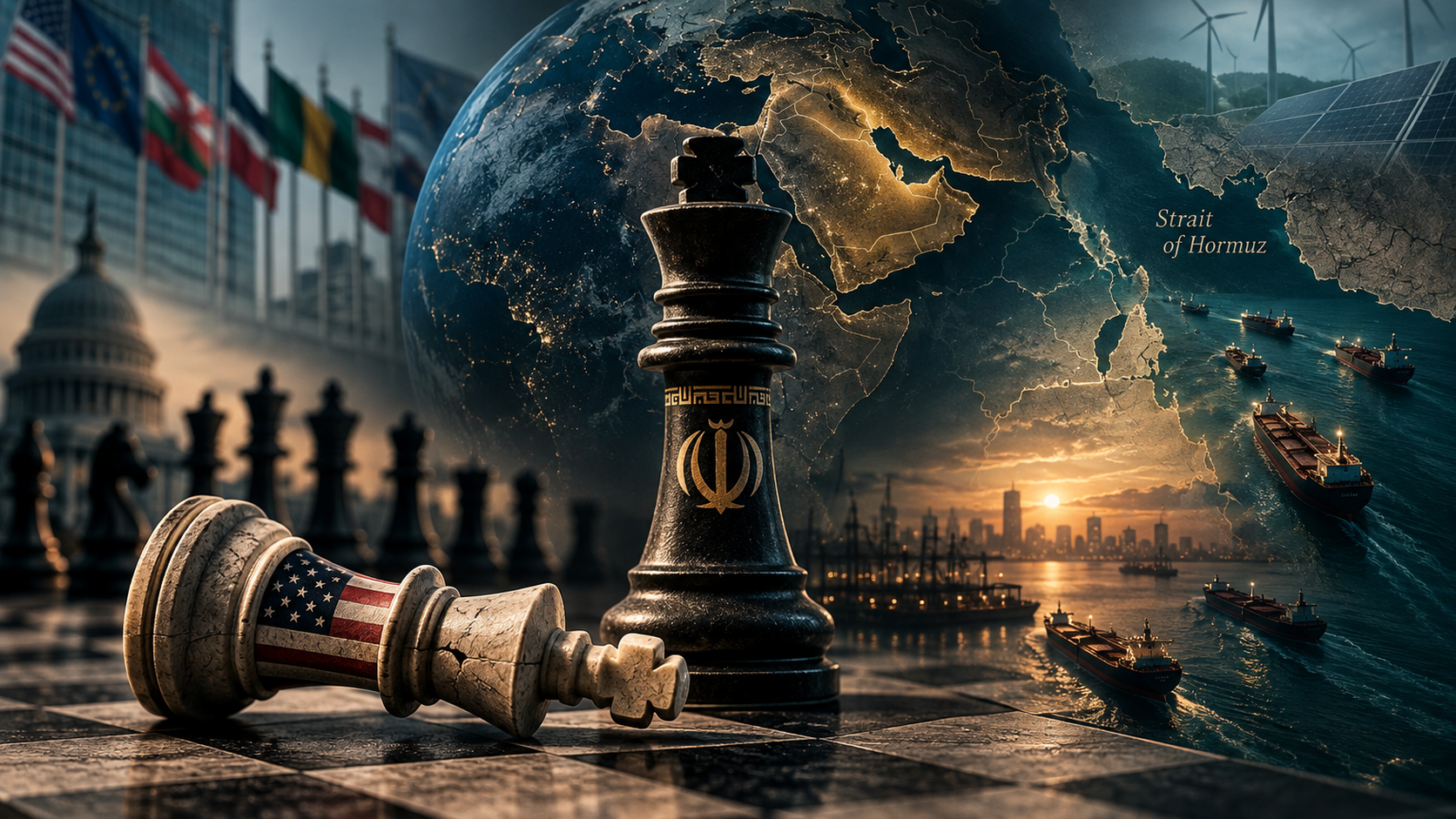
Vietnam, the Gulf War, Iran, and the dangerous assumption that overwhelming capability guarantees success.
I've been thinking about the 1991 Gulf War and how differently the United States approached that conflict compared with what we're witnessing in Iran today.
But the more I've thought about it, the more I've realized this isn't really an article about military power.
It's about systems.
More specifically, what happens when a country possesses extraordinary military, intelligence, financial, and technological capabilities but discovers that those capabilities cannot guarantee the outcome it wants?
And what happens when much of the world has built its economic and security assumptions around the belief that they can?
Three wars, three very different lessons
Vietnam taught the United States a painful lesson.
America possessed overwhelming advantages in firepower, aviation, logistics, and technology. Yet those advantages could not produce the political outcome Washington wanted.
North Vietnam didn't have to defeat the American military in a conventional contest. Its leadership needed to survive, maintain its political objectives, and sustain a conflict that the United States eventually became unwilling to continue.
Military superiority wasn't enough.
Then came the 1991 Gulf War.
When Saddam Hussein invaded Kuwait in August 1990, the United States didn't simply deploy its military and begin attacking Iraq.
It assembled a coalition of approximately 35 nations.
The effort involved diplomacy, international authorization, regional cooperation, intelligence, logistics, and a clearly defined objective.
Remove Iraqi forces from Kuwait.
After weeks of air operations and a ground campaign lasting just 100 hours, Kuwait was liberated.
It was an extraordinary demonstration of American military superiority.
But I think we've misunderstood part of the lesson.
The United States didn't succeed simply because it had the most powerful weapons. It succeeded because those weapons were part of a much larger system designed to achieve a specific result.
The coalition wasn't incidental to that system.
It was an essential component.
And the success of the Gulf War helped reinforce a belief that would shape American strategic thinking for decades: overwhelming military superiority could produce decisive results.
Iran is now testing the limits of that assumption.
What if we're measuring the wrong things?
The United States possesses extraordinary military capabilities.
Aircraft carriers, advanced aircraft, satellites, intelligence networks, precision weapons, missile defenses, and the ability to project military power almost anywhere in the world.
But here's the question that keeps bothering me.
What if we're measuring our capabilities against an adversary's weapons rather than against what that adversary actually wants?
American intelligence agencies and diplomats have spent decades studying Iran. I don't doubt that many of those people understand Iranian history, political institutions, and strategic objectives extraordinarily well.
But understanding something and allowing that understanding to determine policy are two different things.
Political leaders operate within their own system of incentives, including elections, ideology, alliances, domestic constituencies, and competing priorities.
The information may exist.
That doesn't guarantee that decisions reflect it.
I've encountered versions of this problem throughout my career in technology and financial systems.
You can build an extraordinary system that performs exactly as designed and still discover that it isn't solving the problem you actually needed to solve.
Building a system correctly isn't the same as building the correct system.
What does Iran consider success?
The Trump administration has identified preventing Iran from obtaining nuclear weapons as a central objective of the conflict, alongside degrading its missile capabilities, naval forces, and support for regional armed groups.
Those are measurable military objectives.
But suppose Iran's leadership is measuring success differently.
Imagine, for a moment, treating the Iranian regime as a single individual.
Like most people, its first concern is survival.
After survival comes security.
Then influence, followed by a desire for greater control over the environment that determines its future.
And here's the problem.
There's never necessarily a point at which that individual feels completely secure.
Greater influence creates new rivals. Greater control creates resistance. Every additional security measure may generate a new threat.
The pursuit of security becomes a cycle.
Now apply that thinking to Iran's leadership.
Its fundamental objective may be preserving the regime, ensuring that outside powers cannot dictate its future, and maintaining enough regional influence to make its continued existence a strategic reality that other governments must accommodate.
That doesn't mean Iran's leaders all think alike or that their ambitions are limited to survival. Ideology, regional competition, and hostility toward Israel also shape Iranian policy.
But regime survival provides a useful starting point for understanding the leadership's willingness to endure substantial costs.
And that brings me to what may be the most uncomfortable question of this entire conflict.
What if Iran doesn't need a nuclear weapon to achieve many of its strategic objectives?
The Strait of Hormuz changes the equation
Iran cannot match American military power.
It doesn't need to.
Consider the Strait of Hormuz.
Before the war, approximately one-fifth of global petroleum liquids consumption and more than one-fifth of international liquefied natural gas trade moved through this narrow maritime passage.
Nearly 90% of the crude oil and condensate passing through it was destined for Asian markets.
Think about what that means.
An enormous portion of international energy commerce depends on the security of a relatively small geographic area.
Iran doesn't have to defeat the American Navy to disrupt that commerce.
It only needs to make commercial shipping sufficiently dangerous, expensive, or unpredictable that shipowners, insurers, energy companies, and governments must reconsider their decisions.
An American aircraft carrier can project enormous military power.
It cannot, by itself, guarantee that an insurance company will consider a shipping route safe.
An intelligence network can identify threats.
It cannot necessarily eliminate the economic uncertainty those threats create.
And destroying military infrastructure doesn't automatically eliminate the political motivations or technical knowledge that allowed an adversary to develop those capabilities in the first place.
The cost of creating uncertainty can be vastly smaller than the cost of eliminating it.
Iran has suffered substantial military and economic damage. Its population has paid an enormous price, and its conventional capabilities have been degraded.
But being weakened isn't necessarily the same as being strategically defeated.
If Iran's leadership can survive, retain meaningful bargaining leverage, and demonstrate that other governments cannot guarantee regional stability without addressing Iranian interests, it may achieve some of its objectives despite enormous losses.
That is not the same as proving Iran has won.
Nor does it make nuclear weapons irrelevant. Nuclear deterrence serves purposes that disruption of commercial shipping cannot replicate.
But it does challenge the assumption that preventing Iran from obtaining a nuclear weapon would, by itself, resolve the underlying strategic problem.
Military superiority measures what you can do to an adversary. Strategic success measures whether doing it accomplishes what you wanted.
The coalition was part of the operating system
There's another important difference between 1991 and today.
The United States entered the current conflict alongside Israel without first assembling a comparably broad international coalition around a common political and military objective.
Other countries have provided defensive assistance and pursued diplomatic efforts, but the international framework is fundamentally different from the coalition assembled to liberate Kuwait.
And that matters.
In 1991, diplomacy, international legitimacy, shared resources, regional cooperation, and military power worked toward a relatively limited objective.
Today, the United States can achieve substantial military results while still facing unresolved questions about the political settlement necessary to produce lasting stability.
The distinction reminds me of something familiar in systems engineering.
A component can function perfectly while the larger system fails.
A sophisticated financial platform can process transactions flawlessly while its underlying business model becomes unsustainable.
An AI system can deliver technically impressive results while optimizing for the wrong objective.
And a military can destroy its assigned targets without achieving the political outcome that justified the operation.
The performance of the components doesn't guarantee the success of the system.
The invisible infrastructure of globalization
The 1991 Gulf War had consequences extending far beyond Kuwait.
It reinforced confidence in American military power and in the international security arrangements supporting global commerce.
Of course, globalization had many causes, including technological innovation, trade liberalization, communications infrastructure, and changing economic policies.
But security was part of the equation.
Businesses could invest in international supply chains partly because they expected critical shipping routes to remain accessible.
Countries could make economic decisions knowing that American security commitments provided a powerful backstop.
Insurance companies could price risk based on assumptions about the relative stability of international transportation.
Those assumptions had enormous economic value.
American military power, together with alliances and international cooperation, became part of the invisible infrastructure supporting globalization.
But what happens when confidence in that infrastructure begins to change?
Japan, South Korea, Europe, and the Gulf states have different security relationships with the United States.
The Iran conflict doesn't automatically invalidate those commitments.
But governments and businesses make decisions based on expectations about the future.
If they begin questioning whether American military superiority can reliably deliver the stability they have come to expect, they may reconsider their investments, partnerships, defense spending, and supply chains.
And those decisions can reshape the global economy long after the fighting stops.
What happens when America weakens its own system?
There's another dimension to this problem.
The United States spent decades helping build international institutions, trade relationships, diplomatic networks, and security alliances.
Those arrangements weren't simply expressions of goodwill.
They helped multiply American influence.
After World War I, the United States declined to join the League of Nations. After World War II, American leaders took a different approach, helping establish the United Nations and a network of international institutions intended to support cooperation and stability.
That system helped make American influence something more than military superiority.
Yet today, important parts of that international framework are being reconsidered, reduced, or renegotiated.
Foreign assistance programs have been sharply reduced. Participation in international organizations has been curtailed. Trade relationships with longstanding partners have faced tariffs and renewed uncertainty.
Supporters of these policies argue that they reduce costs, restore negotiating leverage, and protect American sovereignty.
But there's a larger systems question worth asking.
Can the United States reduce its investment in the relationships that historically amplified its power while continuing to expect the same degree of international influence?
Iran, Russia, and China don't necessarily need to coordinate their strategies to recognize opportunities created by uncertainty about American commitments.
Each has different objectives and competing interests.
But each can exploit vulnerabilities in an international system whose members are reconsidering their relationships with Washington.
America's military capabilities may remain extraordinary while its ability to translate those capabilities into international cooperation becomes more complicated.
That's a different kind of strategic vulnerability.
The energy system may be changing beneath our feet
There's another consequence of the Iran conflict that I believe deserves more attention.
The world has spent more than a century building an economic system heavily dependent on petroleum.
That system includes pipelines, refineries, shipping networks, financial markets, military security arrangements, and enormous amounts of infrastructure.
It's sophisticated.
It's expensive.
And it contains critical vulnerabilities.
The Strait of Hormuz is one of them.
But other countries are increasingly responding to energy insecurity by investing in ways to reduce their dependence on imported fossil fuels.
Across Europe and Asia, renewable energy, electrification, storage, and other forms of domestic energy production are becoming matters of economic and national security.
China has made enormous investments in solar power, batteries, and electric vehicles. European countries are expanding renewable generation and reconsidering their exposure to imported energy. Asian governments are responding to the current disruption with new energy-security and diversification measures.
The transition is uneven. Petroleum will remain important for years, and alternatives introduce dependencies of their own.
But the direction raises an interesting question.
What happens when protecting the existing energy system becomes increasingly expensive while other countries invest in reducing their dependence on it?
The United States has enormous investments in petroleum production, transportation, and the security arrangements that help protect international energy commerce.
Those investments remain economically valuable.
But they also create incentives to preserve the existing system.
And history is full of examples of powerful organizations becoming so committed to protecting what made them successful that they struggle to adapt when the environment changes.
The danger isn't that petroleum disappears tomorrow.
The danger is that protecting yesterday's infrastructure can begin competing with investment in tomorrow's capabilities.
There's an irony here for Iran as well.
If threatening petroleum transportation creates short-term strategic leverage, but also accelerates the world's efforts to reduce dependence on imported petroleum, Iran could eventually weaken one of its own sources of influence.
A strategy can produce short-term advantages and long-term disadvantages simultaneously.
That's how complex systems behave.
The problem isn't necessarily the technology
For decades, I've worked with technology, financial infrastructure, and complicated operating systems.
One lesson keeps appearing.
Having the best technology doesn't guarantee that you've built the right system.
And even building the right system doesn't guarantee success if you've misunderstood the environment in which it operates.
Vietnam demonstrated that overwhelming military superiority could fail to produce a political objective.
The 1991 Gulf War demonstrated what military superiority could accomplish when combined with a broad coalition and a clearly defined mission.
Iran raises the question of whether extraordinary military capabilities can produce lasting strategic results against an adversary whose definition of success may be fundamentally different.
It also exposes the vulnerabilities of the larger economic and diplomatic systems surrounding military power.
The question isn't whether America has enough aircraft carriers, missiles, satellites, or intelligence capabilities.
It possesses extraordinary resources.
The question is whether those capabilities, together with the strategy and institutions directing them, are sufficient to achieve the intended outcome.
And whether we've become so confident in what our systems can do that we've stopped questioning whether we're solving the right problem.
Perhaps the greatest vulnerability of a sophisticated system isn't what it cannot do, but our assumption that what it can do guarantees the result we want.
That is the lesson I keep coming back to.
Iran may not need a nuclear weapon to achieve some of what its leadership considers strategic success.
The United States may not need more powerful weapons as much as it needs a clearer understanding of how military capability, diplomacy, economics, and political objectives fit together.
And the world may be discovering that the security arrangements it has relied upon for decades cannot be taken for granted.
The consequences of this conflict could persist long after the fighting ends.
Not simply because of who wins or loses.
But because the assumptions underlying the larger international system may be changing.
The most dangerous thing about having the world's most powerful systems may be believing that their power guarantees their success.
Sources
U.S. Department of State: The Gulf War, 1990–1991
White House: Official objectives of Operation Epic Fury
Chatham House: The wishful thinking behind the war with Iran
Chatham House: How will the Iran war reshape the Persian Gulf?
Al-Monitor: After six months, the Iran war reaches a costly stalemate
U.S. Energy Information Administration: World Oil Transit Chokepoints
Financial Times: Iran attacks tankers beyond the Strait of Hormuz
Reuters: US-Iran war spurs Europe and Asia to boost renewables
Reuters: Asia responds to the Iran war with energy diversification