There was a time, not that long ago, when people were afraid to enter their credit card information into a website.
I remember early users trying to physically insert their credit cards into their computer’s CD-ROM drives, believing the card had to be somehow read by the machine in order to complete an online purchase.
It sounds funny today, but it illustrates something important about technological transformation: people initially understand new systems through old mental models.
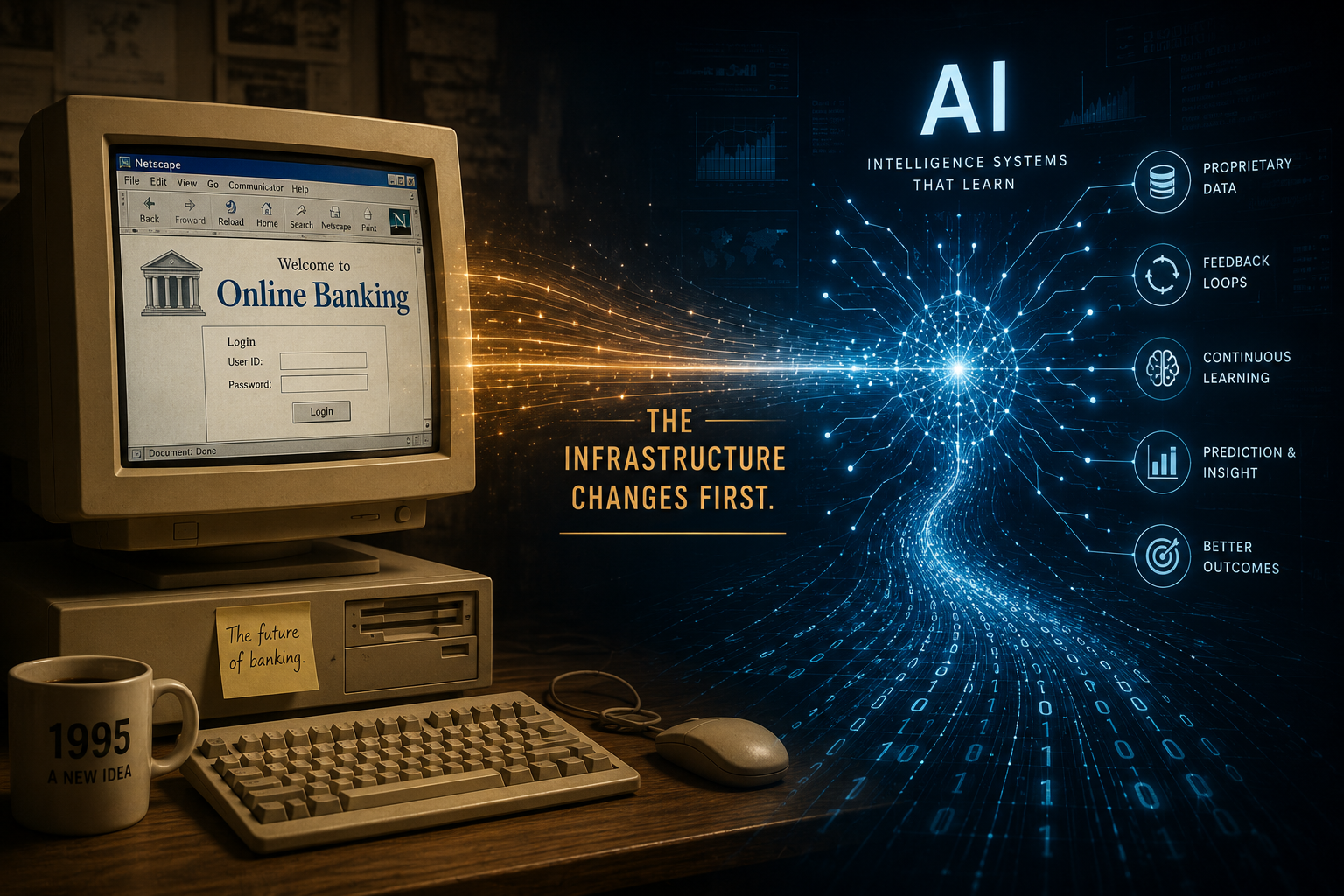
When I helped launch one of the first online banking platforms, I had to convince not only customers, but regulators, including the FDIC and the U.S. Treasury, that online banking was even possible.
At the time, banking meant physical branches, tellers, paper forms, signatures, vaults, and receipts. The idea that a bank branch could become software felt radical.
Today, no one questions it.
I believe artificial intelligence is at a similar moment.
Most people still think AI means chatbots, image generators, cheating on homework and tests, or tools that help write emails. That is like believing the internet was merely a faster fax machine.
Useful, yes. Transformational? Not yet.
The real power of AI is not in chat.
The real power lies in intelligence systems that continuously learn from proprietary data.
That brings me to something many businesses still misunderstand.
AI is not the product.
Data is.
Google is not really just a search engine. It is an intent-capture engine that monetizes what people want, search for, click, compare, and eventually buy.
Facebook and Instagram are not just social networks. They are behavioral intelligence platforms that learn what triggers attention, emotion, identity, outrage, aspiration, and purchase behavior.
Amazon is not just a store. Apple is not just a device company.
The visible product attracts users.
The invisible engine captures intelligence.
That same pattern is now emerging across industries.
The winners in AI may not be the companies with the biggest models. They may be the companies with the best proprietary data and the strongest feedback loops.
Models are becoming cheaper and more accessible every month.
Unique data is not.
This matters enormously in healthcare, biology, and diagnostics.
If your AI is trained on public or rented datasets, your competitive advantage is fragile. The data provider can change pricing, restrict access, or give the same data to your competitors.
Without proprietary intake, you are building on borrowed land.
That is why I believe the future belongs to systems that control data acquisition at the source.
The companies that own the intake layer will own the intelligence layer.
This is not a new pattern.
I have spent much of my career solving what I call “big dumb problems” — industries filled with fragmented systems, disconnected workflows, and data trapped in silos.
The opportunity is rarely in inventing every component from scratch.
The opportunity is in orchestrating disparate systems into a unified intelligence engine.
That was true in online banking.
It is true in AI.
And I believe it will remain true in the years ahead.
The biggest AI breakthroughs may not arrive with dramatic headlines. They may arrive quietly, through small, nimble teams using agentic systems to do the work that once required billion-dollar organizations.
I have watched this happen before. Online banking did not replace branches overnight. It quietly rewrote the infrastructure beneath them.
I believe AI will follow a similar path.
By the time most people notice the change, the systems underneath will already be different.
That is how real transformation usually happens.
Slowly, then all at once.