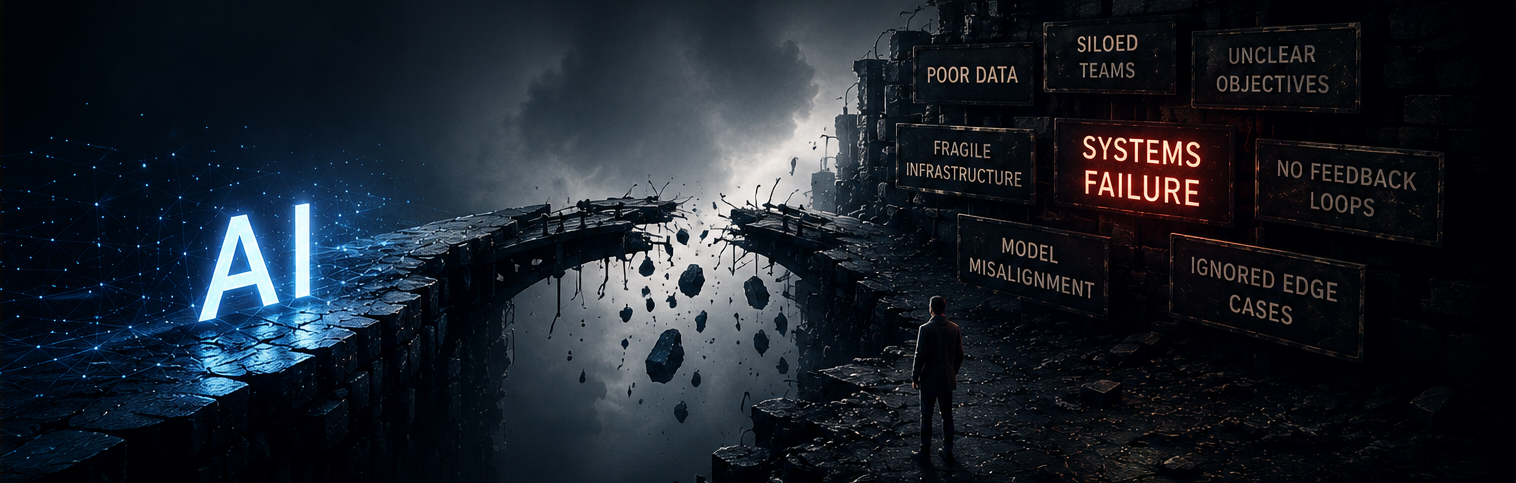
Most AI failures are blamed on the AI itself.
The model was not accurate enough. The responses felt strange. The hallucinations were problematic. The data quality was not ideal.
Those things matter, but in many cases, the AI is not the real point of failure.
The surrounding system is.
Over the years, I have worked on banking systems, AI-driven wellness platforms, security technology, and hardware/software integrations. The pattern is surprisingly consistent: organizations often try to insert AI into workflows that were never redesigned to support it.
The result is predictable.
The AI may function technically, but the operational model around it remains fragile, inefficient, expensive, confusing, or dependent on human behaviors that do not scale.
That is where most failures actually begin.
In one project, the challenge was not simply generating personalized experiences. AI could already do that reasonably well. The real problem was the production pipeline around the content itself: recording schedules, editing workflows, dependency on human availability, localization costs, and ongoing content freshness.
AI became valuable only after the surrounding system was redesigned.
In another case involving security concepts, the core issue was not whether AI could recognize suspicious behavior. The deeper issue was that traditional safety systems depended too heavily on human reaction time during moments of panic, confusion, or danger.
The technology mattered, but the system assumptions mattered more.
This happens constantly.
Companies focus intensely on model selection while ignoring operational friction, trust, escalation paths, human behavior, deployment environments, latency, workflow redesign, and long-term maintenance realities.
AI is often treated like a feature.
In practice, successful AI systems usually require architectural thinking. The surrounding processes, responsibilities, interfaces, and failure conditions must evolve alongside the intelligence layer itself.
Otherwise, the organization creates an illusion of innovation sitting on top of unchanged infrastructure.
Eventually, reality catches up.
Ironically, the strongest AI implementations are often the least theatrical. They quietly remove friction, reduce operational burden, improve consistency, or solve a bottleneck that previously required disproportionate human effort.
The AI is not the product.
The system is.
And in many cases, whether an AI product succeeds has less to do with the sophistication of the model and far more to do with whether the surrounding ecosystem was designed to support intelligence in the first place.